The article compares two forex trading approaches on the same M15 chart after a Break of Structure: an impulsive breakout entry versus a patient entry waiting for price to retrace into a Fair Value Gap (FVG). Using Smart Money Concepts, it demonstrates how the FVG entry produces a tighter stop loss and significantly better risk-to-reward ratio (1:4.8 versus 1:1.7) for the same directional trade.
The piece explains the underlying market mechanics of expansion and retracement, arguing that waiting for price to fill imbalances before continuing allows traders to enter at better prices with lower risk. It concludes that patience, rather than chasing breakouts, provides a measurable trading edge through improved capital efficiency and reduced drawdown exposure.
The Patient Edge: Why Smart Money Traders Wait for the FVG Instead of Chasing the Break
There is a moment every trader knows well. Price breaks a key level, momentum surges, and every instinct screams get in now. What separates consistently profitable traders from the rest is what happens next. The impatient trader clicks the button. The patient trader waits.
This single decision — entering on the breakout versus waiting for the retracement into a Fair Value Gap — can be the difference between a 1:1.7 risk-to-reward and a 1:4.8. Same chart. Same setup. Completely different outcome.
Two Traders, One Chart, Opposite Results
Looking at a real M15 chart on MT5, two distinct entry opportunities present themselves after a Break of Structure to the downside.
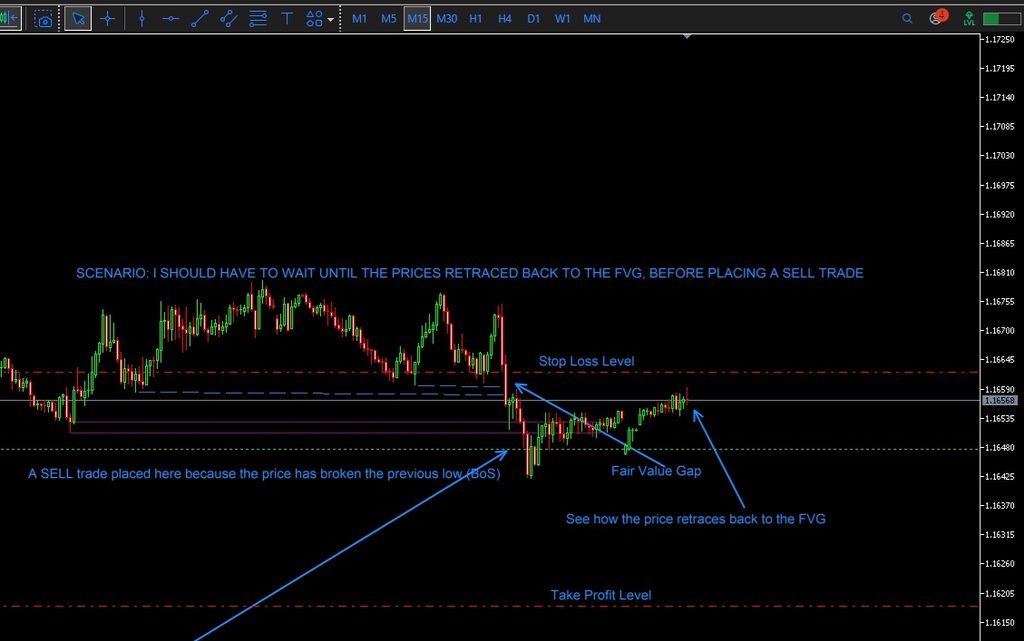
| Execution Metric | Impulse/Breakout Entry (Impatient) | FVG Premium Retracement (Patient) |
| Entry Price | ~1.16480 (Right at the Break of Structure) | ~1.16568 – 1.16590 (Inside the M15 FVG) |
| Stop Loss (SL) | Above Swing High (~1.16645) | Above Swing High (~1.16645) |
| SL Distance | ~16.5 pips (Wide) | ~5.5 to 7.5 pips (Tight) |
| Risk-to-Reward (R:R) | ~1:1.7 | ~1:4.8+ |
| Drawdown Exposure | High (Forces you to sit through the entire retrace) | Low (Triggers right near the pivot rejection) |
Trader A — The Impulse Entry:
- Enters short at approximately 1.16480, right at the Break of Structure
- Stop loss sits above the swing high at around 1.16645
- Stop loss distance: roughly 16.5 pips
- Risk-to-Reward: approximately 1:1.7
Trader B — The Patient Entry:
- Waits for price to retrace into the M15 Fair Value Gap between 1.16568 and 1.16590
- Same stop loss above the swing high at 1.16645
- Stop loss distance: only 5.5 to 7.5 pips
- Risk-to-Reward: 1:4.8 or better
Same direction. Same stop. Wildly different reward potential — simply because one trader understood where the market was likely to deliver price before continuing lower.
The Psychology Problem With Chasing Breakouts
Selling immediately at the impulse break forces you into an uncomfortable position. Price does not typically move straight down after breaking structure. It retraces.
For Trader A, that means watching an open short position move roughly 10 pips against them as price fills the imbalance above. For many traders, this is where discipline breaks down. A few red candles later and the position gets closed at a small loss — right before the real move happens.
This is not a coincidence. This is liquidity delivery. Markets expand to break levels, then retrace to rebalance inefficiencies before continuing. The trader who panics during the retracement is essentially funding the entry for the patient trader waiting at the Fair Value Gap.
Why the FVG Entry Changes Everything
Tighter Stops Mean Smarter Risk
When your stop distance is cut nearly in half, your position sizing math changes completely. On the same 1% account risk, the FVG entry gives you more room to size up while maintaining the same dollar risk — or keeps your exposure lower while multiplying your potential payout.
This is what traders mean when they talk about capital efficiency. It is not just about being right. It is about being right in the most optimal location.
You Are Selling Into Premium, Not Discount
Smart Money Concepts operate on a straightforward principle: buy in discount, sell in premium. When you chase a breakout entry, you are selling at the lowest point of local supply — the absolute worst price in the zone. When you wait for the FVG fill, you are selling into premium liquidity where institutional orders are likely resting.
The market is essentially delivering price back to you. You are not chasing it.
The Professional Rule That Changes Your Mindset
“Never sell low in discount. Wait for the market to pay you a premium.”
If price breaks structure and does not leave a clean imbalance, or if it never retraces to your Fair Value Gap — let the trade go. Missing a move costs nothing. Chasing a low-quality entry with a wide stop and poor R:R costs real money, and over hundreds of trades, that cost becomes devastating to an account.
Patience Is the Edge
The chart does not lie. The difference between an impulse entry and a premium retracement entry is not a matter of opinion — it is measurable in pips, in risk-to-reward ratios, and in drawdown psychology.
High patience traders do not win more often because they are luckier. They win more because they understand that:
- Markets move in two phases — expansion and retracement
- Imbalances get filled before continuation
- Tighter stops at better prices equal better outcomes at identical risk
The next time price breaks structure and the urge to jump in hits immediately — pause. Let the market come to you. The FVG is where the real edge lives.